
Understanding and Diagnosing Essential Thrombocythemia (ET) — Animation
Managing and Treating Essential Thrombocythemia (ET) — Animation
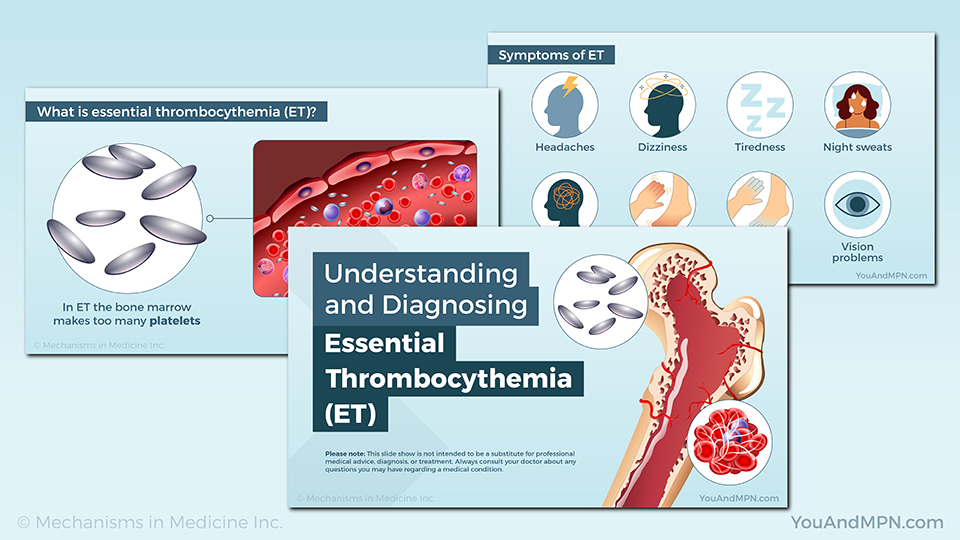
Understanding and Diagnosing Essential Thrombocythemia (ET) — Slide Show
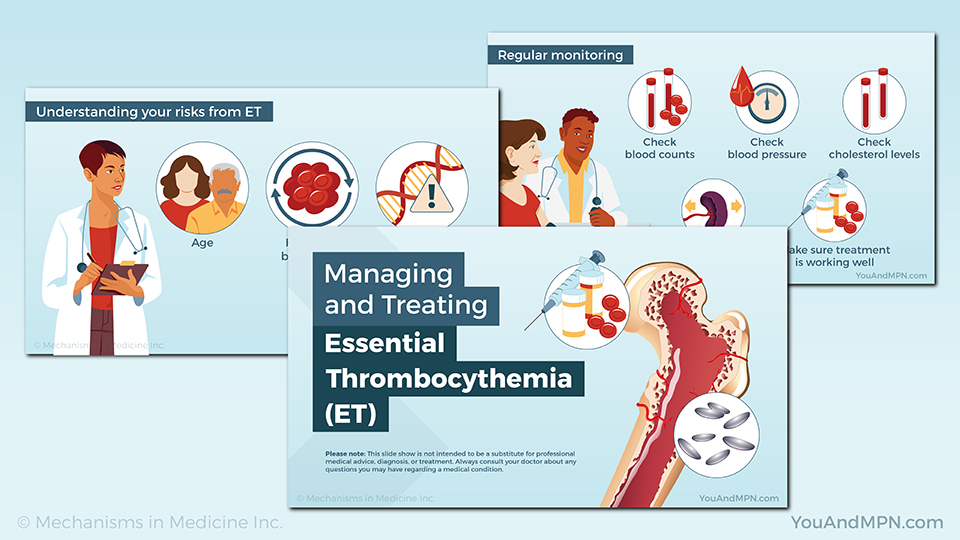
Managing and Treating Essential Thrombocythemia (ET) — Slide Show

1.
What is essential thrombocythemia (ET)?

2.
Why and how did my essential thrombocythemia (ET) arise?

3.
How is essential thrombocythemia (ET) diagnosed?
4.
What are the signs, symptoms, and expectations of living with ET?
5.
What are the risks with essential thrombocythemia (ET)?
6.
How is essential thrombocythemia (ET) managed and treated?

7.
Janeana's story: How did you find out you had essential thrombocythemia (ET)?
8.
Janeana's story: What challenges and successes have you had with ET treatment?
9.
Janeana's story: What advice do you have for others on their journey with ET?
How is essential thrombocythemia (ET) diagnosed? — Expert Video
Dr. Gabriela Hobbs, Clinical Director of Leukemia Service at Massachusetts General Hospital, provides an overview of how essential thrombocythemia (ET) is diagnosed. She explains that ET is often first suspected when a routine blood test shows a high platelet count, though some people seek care for symptoms such as headaches or blood clots. Dr. Hobbs explains that high platelet counts alone are not enough for a diagnosis. Doctors use established criteria that include blood tests for specific genetic mutations, such as
JAK2
,
CALR
, or
MPL
, and often a bone marrow biopsy to confirm ET and rule out other conditions. She also provides an overview of next-generation sequencing (NGS) and variant allele fraction (VAF).
Click here to take our SURVEY
Your feedback is important to us! We will use your feedback to develop future areas of content about myeloproliferative neoplasms which will help other patients, caregivers, and families.
Other Modules:
Understanding and Diagnosing Essential Thrombocythemia (ET) — Animation
Managing and Treating Essential Thrombocythemia (ET) — Animation
Understanding and Diagnosing Essential Thrombocythemia (ET) — Slide Show
Managing and Treating Essential Thrombocythemia (ET) — Slide Show
1.
What is essential thrombocythemia (ET)?
2.
Why and how did my essential thrombocythemia (ET) arise?
3.
How is essential thrombocythemia (ET) diagnosed?
4.
What are the signs, symptoms, and expectations of living with ET?
5.
What are the risks with essential thrombocythemia (ET)?
6.
How is essential thrombocythemia (ET) managed and treated?
7.
Janeana's story: How did you find out you had essential thrombocythemia (ET)?
8.
Janeana's story: What challenges and successes have you had with ET treatment?
9.
Janeana's story: What advice do you have for others on their journey with ET?