




Managing and Treating Polycythemia Vera (PV) — Animation
Click here to take our SURVEY
Your feedback is important to us! We will use your feedback to develop future areas of content about myeloproliferative neoplasms which will help other patients, caregivers, and families.
Other Modules:
Managing and Treating Polycythemia Vera (PV)
If you have polycythemia vera, or PV, getting treatment is vital. Treatment aims to reduce the risk of blood clots and bleeding, strokes, heart attacks, and keep blood counts in a safe range. Treatment also helps manage PV-related symptoms, prevent problems like deep vein or lung clots, and improve how you feel each day.1,2,4
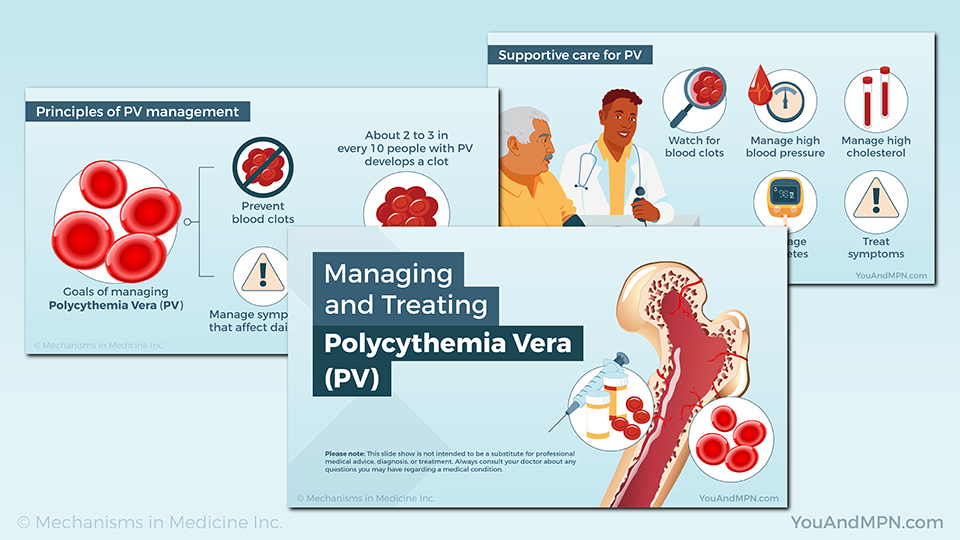
Blood clots are the most serious potential problem. About 2 to 3 in every 10 people with PV develops a clot.1,2
Risk levels when you have polycythemia vera
The type of treatment you receive for polycythemia vera depends on your risk level. Your risk is high if you are over 60 or had a previous blood clot. Your risk is low if you are under 60 and have never had a clot.2,3 Your doctor will also look at factors such as high blood pressure, high cholesterol, and diabetes, since these can raise your risk for heart and blood vessel problems.2 Certain genetic changes in your blood cells may also affect PV over time.
Phlebotomy for polycythemia vera
Phlebotomy is often one of the first treatments for PV. It involves removing blood (much like a blood donation) to lower total red blood cells, thin the blood, and improve circulation. The goal is to keep the percentage of red cells in your blood (hematocrit) under 45%. This lowers the risk of a clot.1,2,5
Low-dose aspirin for polycythemia vera
Some people with PV take low-dose aspirin each day. It helps keep small blood cells called platelets from clumping together and forming clots. This lowers the risk of heart attacks and strokes.1,2
Treatment for low-risk polycythemia vera patients
For low-risk patients, phlebotomy plus low-dose aspirin is often enough to keep the percentage of red cells in the blood below 45% and prevent problems.1,2,3
Medicines for high-risk polycythemia vera patients
People with high-risk polycythemia vera often need medication in addition to low-dose aspirin. Medication reduces or slows the number of blood cells bone marrow makes. This reduces the risk of blood clots and helps control symptoms.2,3,5 You may still have phlebotomy, but medication will be the main treatment.
Hydroxyurea for polycythemia vera
Hydroxyurea is another medication for PV. It slows blood cell production in the bone marrow. Your doctor will adjust your dose based on your blood counts and how you respond.
Interferon therapy for polycythemia vera
Interferon is another treatment option for polycythemia vera. Given as a shot, it slows the production of blood cells in the bone marrow. The first interferon specifically for PV was approved by the FDA in 2021. You take interferon every 2 to 4 weeks.1 Side effects can include feeling like you have the flu, headaches, muscle pain or mood changes.1,4
Ruxolitinib for polycythemia vera
Ruxolitinib is an FDA-approved option if hydroxyurea does not work or causes too many side effects. It blocks signals that tell the bone marrow to make too many blood cells. It helps control blood counts, shrink an enlarged spleen and manage other PV symptoms.1,2
Supportive care for polycythemia vera
Supportive care focuses on helping you feel your best. This means watching for blood clots, managing conditions like high blood pressure, high cholesterol and diabetes, and treating symptoms.2,4 Working with your care team and going to appointments regularly helps you stay as healthy as possible.2,3
Polycythemia vera changes over time
Over time, a small number of people with polycythemia vera (about 10 to 15 out of 100) may develop a related condition called post-PV myelofibrosis, where scar tissue builds up in the bone marrow.1,2 This change usually happens slowly, over many years.1,2 In rare cases, PV can also progress to acute leukemia.1,2 Regular checkups and tests help detect these changes early, so your care team can adjust treatment as needed.
Clinical trials and future options for polycythemia vera
New PV treatments are being studied in clinical trials. Researchers are discovering new ways to control blood counts, reduce symptoms, and improve the long-term outlook for people with PV. Talk to your doctor about whether a clinical trial might be right for you.
Team management and moving forward with polycythemia vera
Your care team works together to help manage PV. With the right treatment approach, most people with PV live well and reduce their risk of complications. Stay informed, keep all your appointments, and talk openly with your health care providers about your symptoms, side effects, and concerns. Working with your care team helps you take an active role in living well with PV.
Disclaimer: The information provided is not intended to be a substitute for professional medical advice, diagnosis, or treatment. Always consult your doctor about any questions you may have regarding a medical condition.
References
-
MPN Research Foundation. Polycythemia Vera (PV).
https://mpnresearchfoundation.org/polycythemia-vera-pv - Tefferi A, Barbui T. Polycythemia vera: 2024 update on diagnosis, risk-stratification, and management. Am J Hematol. 2023 Sep;98(9):1465-1487.
-
National Comprehensive Cancer Network. NCCN Guidelines for Patients: Myeloproliferative Neoplasms. Version 2024.
https://www.nccn.org/patientresources/patient-resources/guidelines-for-patients/guidelines-for-patients-details?patientGuidelineId=27 -
Lu X, Chang R. Polycythemia Vera. [Updated 2023 Apr 24]. In: StatPearls [Internet]. Treasure Island (FL): StatPearls Publishing; 2025 Jan-.
https://www.ncbi.nlm.nih.gov/books/NBK557660 -
National Comprehensive Cancer Network. NCCN Clinical Practice Guidelines in Oncology: Myeloproliferative Neoplasms. Version 2.2025.
https://www.nccn.org/guidelines/guidelines-detail?category=1&id=1477