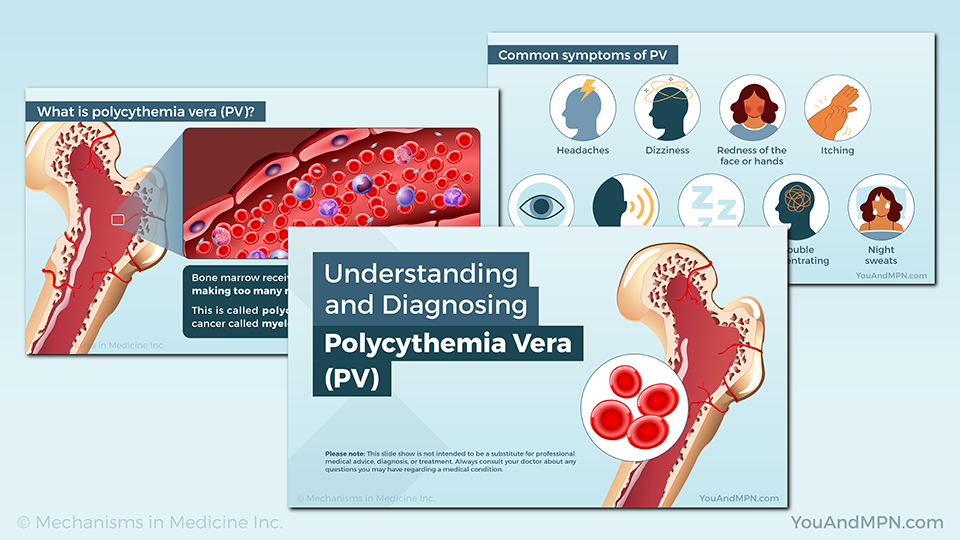
Understanding and Diagnosing Polycythemia Vera (PV)
*Please note: This slide show is not intended to be a substitute for professional medical advice, diagnosis, or treatment. Always consult your doctor about any questions you may have regarding a medical condition.
About your blood cells
Blood flowing through your body contains several different kinds of cells. Red blood cells deliver oxygen to your tissues, white blood cells protect against infections, and platelets form clots to stop bleeding when needed.
About your bone marrow
Your bones contain spongy tissue called bone marrow, where all these blood cells are created. The bone marrow functions like a factory, making the right amount of each blood cell type based on instructions from your genes.
What is polycythemia vera (PV)?
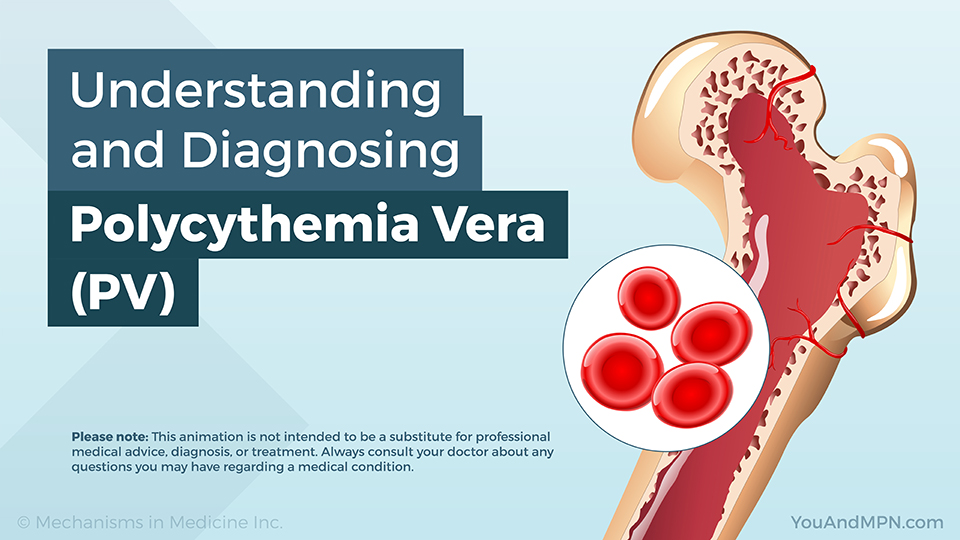
Sometimes, the bone marrow factory receives the wrong instructions and starts making too many red blood cells. This is called polycythemia vera, or PV. It's a type of blood cancer called a myeloproliferative neoplasm, or MPN.
Understanding the name
The name "polycythemia vera" tells us what's happening. "Poly" means many and "cythemia" refers to blood cells. So, polycythemia means you have too many blood cells.
"Vera" means true, meaning it is the primary problem, not caused by something else.
Why too many red blood cells cause problems
Red blood cells carry oxygen throughout your body. But when you have too many, the blood becomes thick and sticky, like honey instead of water.
This thick blood doesn't flow well through your blood vessels. It's harder for oxygen to get where it's needed.1
Serious complications from PV
The thick blood caused by PV can form unwanted clots inside blood vessels. These can lead to heart attacks, strokes, or blockages in the legs.
PV can also cause bleeding problems. In addition, your spleen may become enlarged as it works harder to filter the extra blood cells.1,2
Who gets PV?
PV is most common in people over age 60, though it can happen at any age. Men are slightly more likely than women to develop PV.
PV is rare. Just 1 or 2 people out of every 100,000 are diagnosed each year.2,3
What causes PV?
PV happens because of changes in genes. The medical term for these types of changes is "mutations".
Almost all people with PV have a
mutation in a gene called JAK2. The mutations signal the bone marrow to make too many red blood cells.2,4
How do people discover they have PV?
Many people with PV don't feel sick at first. PV is often discovered during a routine blood test that shows high red blood cell counts or high hematocrit.
Your regular doctor might notice this during a yearly checkup or when testing for another condition.1,2
Common symptoms of PV
When PV does cause symptoms, they can include headaches, dizziness, redness of the face or hands, and itching, especially after a warm bath or shower.
Other symptoms can include blurred vision, ringing in the ears, feeling unusually tired, or having trouble concentrating. Others may experience night sweats.1,3
If you have high red cell counts
If your blood test shows high red blood cell counts, your doctor might refer you to a hematologist—a doctor specializing in blood disorders. They can do more tests to find out what's causing your high blood counts.2-4
Ruling out other causes
Before diagnosing PV, doctors need to rule out other reasons for high red blood cells. They will test for conditions including sleep apnea, lung diseases, heart problems, or problems living at high altitude.2,4
Gene mutation testing
Your hematologist will test your blood for gene mutations. They will look for the
JAK2 mutation, which is present in more than 9 of every 10 people with PV. Finding this mutation helps confirm the PV diagnosis and gives doctors important information about your condition.2,4
Other blood tests
Doctors will measure your red blood cell count, hemoglobin, and hematocrit levels. These tests show how many red blood cells you have and how thick your blood has become. They will also check your level of erythropoietin, or EPO, a hormone that controls red blood cell production. In PV, this level is usually low.2,4
Bone marrow biopsy
Your doctor will take a small sample of bone marrow in a procedure called a biopsy. This helps them see what is happening inside your bone marrow "factory", and make sure it is really PV and not another condition.2,4
Understanding your PV diagnosis
Getting a PV diagnosis can feel overwhelming, but many people with PV live healthy lives with proper treatment. Your care team can guide you through what this diagnosis means for you.1,2
Moving forward after diagnosis
Once PV is diagnosed, your healthcare team will work with you to create a treatment plan that's right for you. Understanding your condition is the first step towards managing it successfully and living well.4,5
References
- MPN Research Foundation. What is polycythemia vera? https://mpnresearchfoundation.org/polycythemia-vera-pv
- Tefferi A, Barbui T. Polycythemia vera: 2024 update on diagnosis, risk-stratification, and management. Am J Hematol. 2023 Sep;98(9):1465-1487.
- Thapa B, Fazal S, Parsi M, Rogers HJ. Myeloproliferative Neoplasms. [Updated 2023 Aug 8]. In: StatPearls [Internet]. Treasure Island (FL): StatPearls Publishing; 2025 Jan–.
https://www.ncbi.nlm.nih.gov/books/NBK531464
- National Comprehensive Cancer Network (NCCN). NCCN Guidelines for Patients: Myeloproliferative neoplasms. Version 2024.
https://www.nccn.org/patients/guidelines/content/PDF/mpn-patient.pdf
- Khoury JD, Solary E, Abla O, Akkari Y, Alaggio R, Apperley JF, Bejar R, Berti E, Busque L, Chan JKC, Chen W, Chen X, Chng WJ, Choi JK, Colmenero I, Coupland SE, Cross NCP, De Jong D, Elghetany MT, Takahashi E, Emile JF, Ferry J, Fogelstrand L, Fontenay M, Germing U, Gujral S, Haferlach T, Harrison C, Hodge JC, Hu S, Jansen JH, Kanagal-Shamanna R, Kantarjian HM, Kratz CP, Li XQ, Lim MS, Loeb K, Loghavi S, Marcogliese A, Meshinchi S, Michaels P, Naresh KN, Natkunam Y, Nejati R, Ott G, Padron E, Patel KP, Patkar N, Picarsic J, Platzbecker U, Roberts I, Schuh A, Sewell W, Siebert R, Tembhare P, Tyner J, Verstovsek S, Wang W, Wood B, Xiao W, Yeung C, Hochhaus A. The 5th edition of the World Health Organization Classification of Haematolymphoid Tumours: Myeloid and Histiocytic/Dendritic Neoplasms. Leukemia. 2022 Jul;36(7):1703-1719.
This slide show helps you understand
polycythemia vera (
PV), a type of
myeloproliferative neoplasm (
MPN) in which the bone marrow produces
too many red blood cells. You'll learn how blood cells are made and why having too many red blood cells can thicken the blood, increasing the risk of
clots (which can cause heart attacks, strokes, or leg blockages),
bleeding problems, and an
enlarged spleen. The slide show also covers key
signs and symptoms, the role of the
JAK2 mutation,
blood tests,
bone marrow biopsy, and steps you can take after diagnosis.
-
Share with family and friends:
Click here to take our SURVEY
Your feedback is important to us! We will use your feedback to develop future areas of content about myeloproliferative neoplasms which will help other patients, caregivers, and families.