Understanding and Diagnosing Myelofibrosis (MF)
About myelofibrosis (MF)
What is an MPN?
Types of myelofibrosis
Who gets MF?
What causes MF?
The role of gene mutations
MF symptoms
How MF affects your organs
Less common symptoms of MF
Steps in diagnosing MF
Confirming the diagnosis
Risks and outcomes
Living with MF
What comes next?
What comes next?
Becoming an advocate for yourself

Understanding and Diagnosing Myelofibrosis (MF)

*Please note: This slide show is not intended to be a substitute for professional medical advice, diagnosis, or treatment. Always consult your doctor about any questions you may have regarding a medical condition.

About myelofibrosis (MF)

Myelofibrosis, or MF, is a rare type of chronic blood cancer where scar tissue can form and build up in the bone marrow with time. This makes it difficult for your body to make normal blood cells.1

What is an MPN?

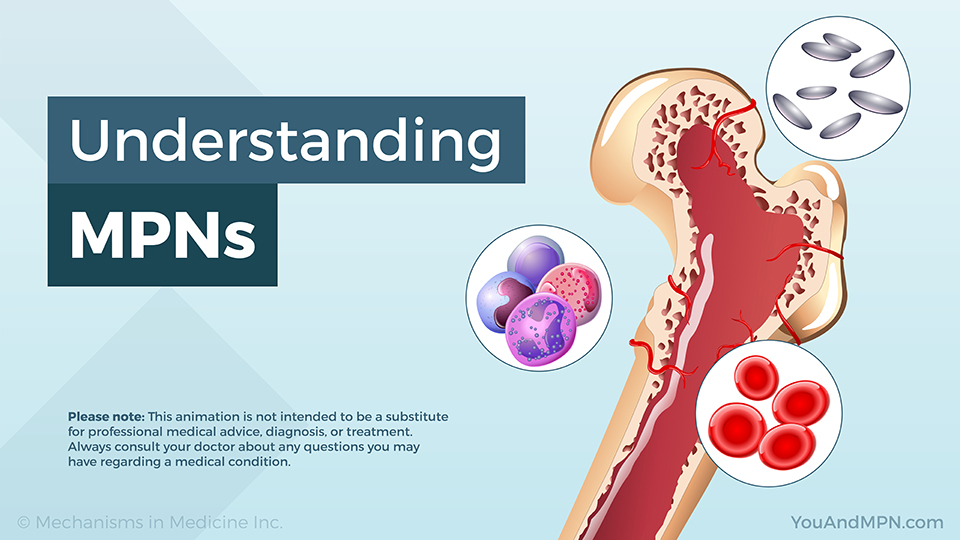
MF is part of a group of blood cancers called myeloproliferative neoplasms, or MPNs. These diseases start with changes in blood stem cells—the cells that make various types of blood cells. All MPNs, including MF, lead to overproduction of blood cells.

Types of myelofibrosis

Some people develop myelofibrosis without having another MPN first. This is called primary MF. Others develop MF after having another MPN, such as polycythemia vera (PV) or essential thrombocythemia (ET). This is called secondary MF.

Treatment is often similar whether you develop primary MF or secondary MF. Your treatment depends on your specific situation.2

Who gets MF?

MF is most common in people over 60, but younger people can get it too. Risk factors can include older age, exposure to certain chemicals or radiation, and having another blood cancer or MPN.3

What causes MF?

MF often starts when a mutation develops in a JAK2, CALR, or MPL gene. MF is generally not inherited.

In rare cases, having a family history of MPNs may slightly increase risk, likely due to shared genetic factors that make these acquired mutations more likely to occur or expand.4

The role of gene mutations

About half of people with MF have a JAK2 mutation. Many others have a CALR or MPL mutation. These activate pathways that make cells grow and divide too much, causing scarring in the bone marrow.1,4

Some people don't have any of these mutations. Their condition is managed the same way, based on symptoms and lab results.

MF symptoms

Early on, MF may not cause symptoms. When they appear, symptoms may include tiredness, weakness, shortness of breath, night sweats, fever, bone pain, and weight loss.1

How MF affects your organs

When the bone marrow can't make enough blood cells, production may shift to the spleen or liver. The spleen can enlarge, causing pain or a full feeling under your ribs. You may also feel dizzy or lightheaded due to too few blood cells.1

Less common symptoms of MF

MF can also cause itching, easy bruising, or bleeding from low platelets (clotting blood cells). You may get infections more often when your white blood cell counts are low. Other symptoms can include trouble concentrating or feeling mentally tired. Everyone is different, and you may have different symptoms over time.1

Steps in diagnosing MF

Doctors often suspect MF after a routine blood test called a CBC. It looks at the number and type of blood cells. Results may show low red blood cells, unusual numbers of white blood cells, or platelet levels that are too high or too low.5

Confirming the diagnosis

Doctors confirm MF with a bone marrow biopsy. This is essential to show scarring and abnormal cells. They will also order testing for JAK2, CALR, or MPL mutations and check the size of your spleen and liver.5

Risks and outcomes

Doctors use scoring systems to better understand how your MF may behave over time and what this may mean for you.

They use information such as your age, symptoms, blood counts, bone marrow biopsy results, and genetic changes. Together, they help estimate both overall survival and the risk that MF could progress to a more aggressive blood cancer, such as acute leukemia.

While some people develop acute leukemia, many do not.

Your score helps your care team choose the most appropriate treatment and understand how closely to watch for changes or complications.6

Living with MF

Living with MF means paying attention to your energy, general health, and risk of infection. It's important to pace yourself daily, eat a balanced diet to maintain strength and feel your best, and tell your care team if you think you are getting sick or have an infection.

Emotional support is important. Joining a patient community or local support group can help reduce stress, encourage you, and remind you that you are not alone.1

What comes next?

After your diagnosis, your care team will talk with you about the next steps. You may see different specialists depending on your specific needs.

What comes next?

Expect regular blood tests, checkups, and changes to your plan as needed.

Staying connected with your doctor and care team helps you and your family stay informed on the latest treatments and feel supported every step of the way.7

Becoming an advocate for yourself

Organizations like the MPN Research Foundation offer advocacy and research updates for people with MF. Getting involved means you can share experiences, find information, and keep up with scientific progress.1

References

  1. Vainchenker W, Constantinescu SN, Plo I. Recent advances in understanding myelofibrosis and essential thrombocythemia. F1000Res. 2016 Apr 19;5:F1000 Faculty Rev-700.
  2. Tefferi A, Lasho TL, Jimma T, Finke CM, Gangat N, Vaidya R, Begna KH, Al-Kali A, Ketterling RP, Hanson CA, Pardanani A. One thousand patients with primary myelofibrosis: the Mayo Clinic experience. Mayo Clin Proc. 2012 Jan;87(1):25-33.
  3. Baxter EJ, Scott LM, Campbell PJ, East C, Fourouclas N, Swanton S, Vassiliou GS, Bench AJ, Boyd EM, Curtin N, Scott MA, Erber WN, Green AR; Cancer Genome Project. Acquired mutation of the tyrosine kinase JAK2 in human myeloproliferative disorders. Lancet. 2005 Mar 19-25;365(9464):1054-1061. Erratum in: Lancet. 2005 Jul 9-15;366(9480):122.
  4. Koren-Michowitz M. Genetic predisposition to myeloproliferative neoplasms: another piece of the puzzle. Acta Haematol. 2018;139(4):238-239.
  5. Salama ME. Important pathologic considerations for establishing the diagnosis of myelofibrosis. Hematol Oncol Clin North Am. 2021 Apr;35(2):267-278.
  6. Passamonti F, Cervantes F, Vannucchi AM, Morra E, Rumi E, Pereira A, Guglielmelli P, Pungolino E, Caramella M, Maffioli M, Pascutto C, Lazzarino M, Cazzola M, Tefferi A. A dynamic prognostic model to predict survival in primary myelofibrosis: a study by the IWG-MRT (International Working Group for Myeloproliferative Neoplasms Research and Treatment). Blood. 2010 Mar 4;115(9):1703-1708.
  7. Tefferi A. How I treat myelofibrosis. Blood. 2011 Mar 31;117(13):3494-3504.

Understanding and Diagnosing Myelofibrosis (MF) — Slide Show
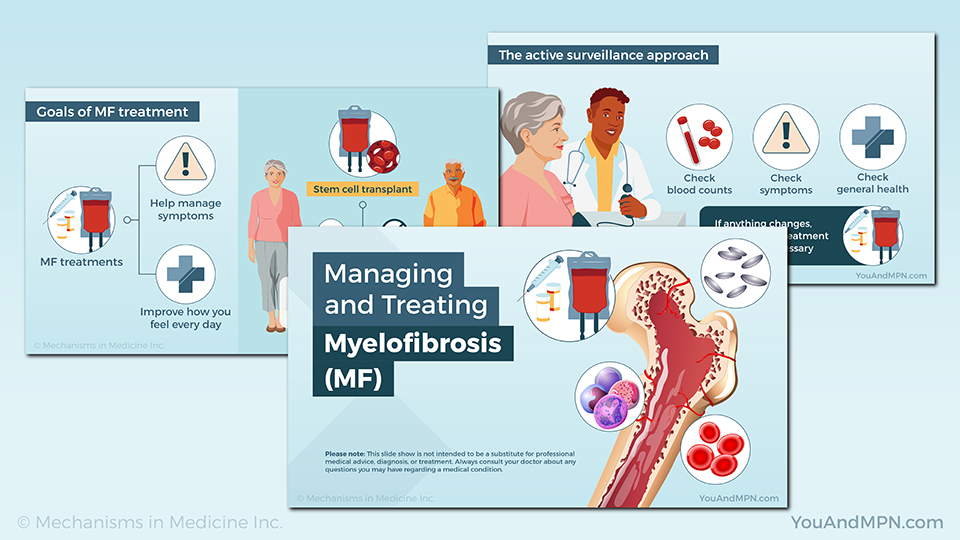
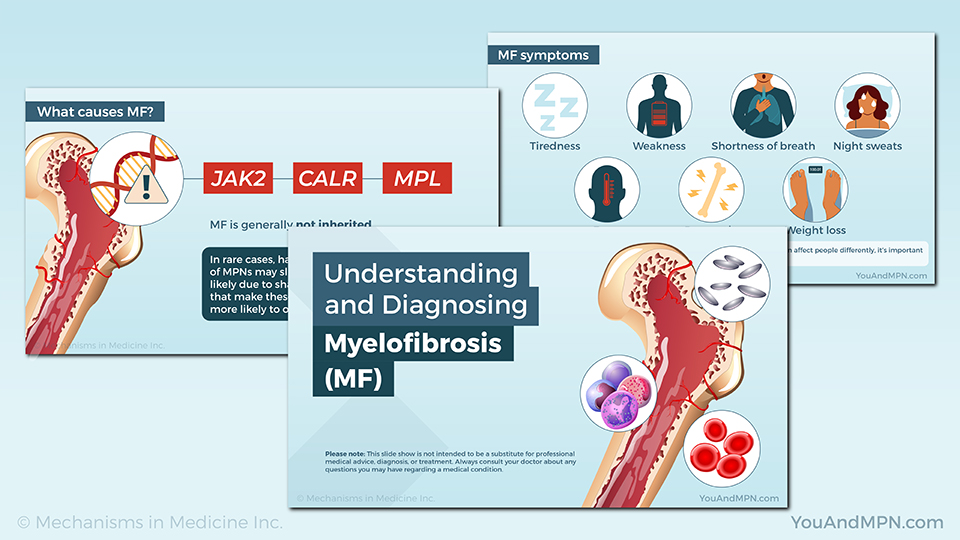
This slide show helps you understand myelofibrosis (MF), a type of myeloproliferative neoplasm (MPN) in which scar tissue builds up in the bone marrow and interferes with normal blood cell production. You'll learn how MF develops, the role of gene mutations such as JAK2, CALR, and MPL, and the difference between primary and secondary MF. The slide show also explains common symptoms, how MF can affect organs like the spleen, how doctors confirm the diagnosis through blood tests and bone marrow biopsy, and what to expect after diagnosis.

  • Share with family and friends:

Click here to take our SURVEY
Your feedback is important to us! We will use your feedback to develop future areas of content about myeloproliferative neoplasms which will help other patients, caregivers, and families.

Other Modules: