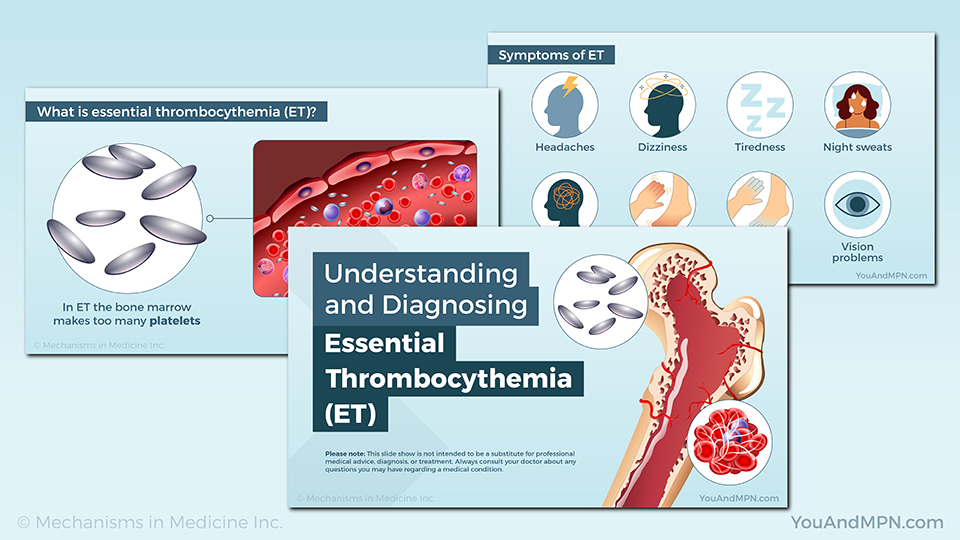
Managing and Treating Essential Thrombocythemia (ET)
*Please note: This slide show is not intended to be a substitute for professional medical advice, diagnosis, or treatment. Always consult your doctor about any questions you may have regarding a medical condition.
Managing essential thrombocythemia (ET)
The goals of managing essential thrombocythemia (ET) are reducing the risk of blood clots and bleeding, preventing heart attack and stroke, managing any symptoms, and helping you maintain a good quality of life.1
Managing essential thrombocythemia (ET)
You can work with your healthcare team to create a treatment plan that fits your specific needs.
Understanding your risks from ET
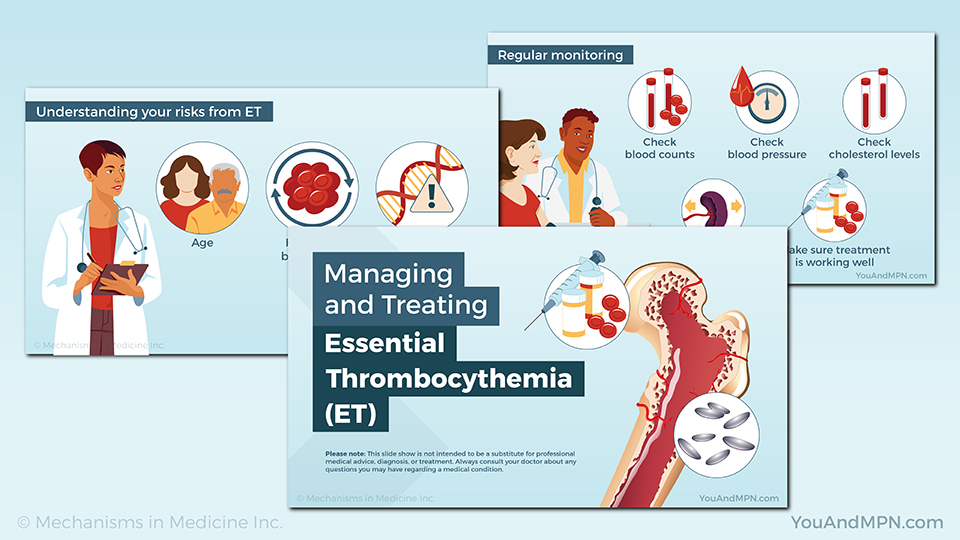
The right treatment depends on several factors. Your doctor will assess your risk for blood clots based on your age, whether you've had any before, and whether you have certain gene mutations, like JAK2, CALR, or MPL.2
ET risk categories
Doctors group ET into risk categories. Very low risk means you're under 60 with no JAK2 mutation and no history of blood clots. Low risk is under 60 with the JAK2 mutation and no clots.
Intermediate risk means you are over 60 but do not have a JAK2 mutation or blood clots. High risk means you are over 60 with a JAK2 mutation and have had blood clots.2,3 Your risk level helps determine the best treatment.
Lifestyle changes when you have ET
No matter your risk level, healthy lifestyle choices are important. Regular exercise, healthy weight, a balanced diet, reducing stress, and not smoking all help reduce the risk of blood clots and improve your overall health.2
Managing other health conditions
It's important to manage any other health conditions that raise your risk of heart problems and blood clots, such as high blood pressure, diabetes, or high cholesterol.1
Low-dose aspirin for ET
One ET treatment is low-dose aspirin, which helps keep platelets from sticking together and forming clots. Aspirin can also relieve burning or tingling in your hands and feet, which some people with ET experience.1
However, if your platelet count is very high (over 1 million) your doctor may not recommend aspirin because it can increase your risk of bleeding.
Cytoreductive therapy
Medications called cytoreductive therapies are another option. They help reduce the number of platelets your bone marrow makes and can help symptoms.1
Hydroxyurea
Cytoreductive therapies include hydroxyurea, which is a medication that slows down how quickly your bone marrow makes blood cells, including platelets. You take it by mouth, and your doctor adjusts the dose based on your blood counts.1,3
Anagrelide
Your doctor might prescribe anagrelide to reduce platelet production if hydroxyurea doesn't work well or causes side effects you can't tolerate.1,3
You take anagrelide as a daily capsule. The dose is adjusted to keep your platelets at a safe level. It can affect the heart, so may not be a good option if you have heart rhythm problems.
Interferon therapy
Pegylated interferon helps control blood cell production in a different way. It's given as an injection you can do at home.1,4
This treatment is considered safer or preferred when treatment is needed during pregnancy, so it's often used for younger patients or women who are pregnant or planning to become pregnant.
Newer therapies for advanced disease
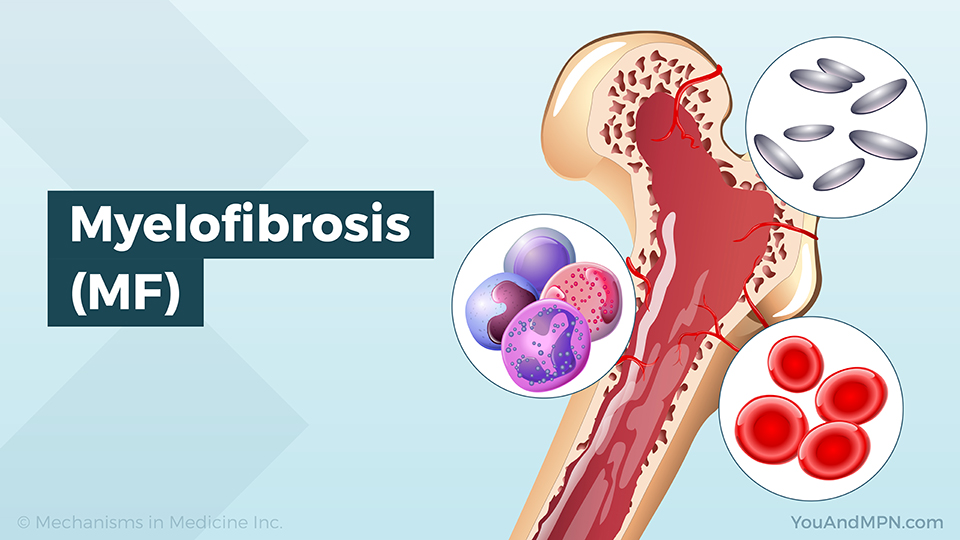
Over time, a small number of people with ET (about 5 to 10 out of 100) may develop a condition called post-ET myelofibrosis, where scar tissue builds up in the bone marrow.
If this happens, your doctor will talk with you about different treatment options, since management for myelofibrosis is different from ET.4
Regular monitoring
No matter what treatment you receive, regular checkups are essential. Your healthcare team will check your blood counts, blood pressure, and cholesterol levels. They will also check for signs of an enlarged spleen and make sure your treatment is working well.1
Regular monitoring
It's also important to track your symptoms over time so you can notice any changes. Tell your team about any new symptoms right away.
Clinical trials and research
Researchers are developing new ET treatments.
Talk with your doctor about whether a clinical trial might be right for you. Organizations like the MPN Research Foundation and National Cancer Institute have information on available trials.
Quality of life
Living with ET is about more than just your blood counts. Your treatment should help you feel better and do the things you enjoy.
Quality of life
Tell your doctor if you have fatigue, difficulty concentrating, or other symptoms that affect your daily life.1 You may need additional support or an adjustment in your treatment.
Looking forward
With proper monitoring and treatment, many people with ET can live long, full lives.1,3 Stay informed about your condition, work closely with your healthcare team, and remember that you’re not alone on this journey.
References
- MPN Research Foundation. Managing and treating essential thrombocythemia.
https://mpnresearchfoundation.org/essential-thrombocythemia-et
- Tefferi A, Pardanani A. Essential thrombocythemia: 2024 update on diagnosis, risk stratification, and management. Am J Hematol. 2024;99(4):697-719.
- Tefferi A, Vannucchi AM, Barbui T. Essential thrombocythemia treatment algorithm 2018.
Blood Cancer J. 2018;8(1):2.
- Masarova L, Chifotides HT. How I individualize selection of JAK inhibitors for patients with myelofibrosis. Blood. 2025;145(16):1724-1737.
This slide show explains how the
management and
treatment of
essential thrombocythemia (
ET) focuses on
lowering the risk of blood clots and bleeding,
preventing heart attack and stroke,
managing symptoms, and
supporting quality of life. You'll learn how doctors determine
risk level based on age, clot history, and gene mutations, and how that guides treatment decisions. The slide show reviews
healthy lifestyle changes,
low-dose aspirin, and medications, including
cytoreductive therapy (hydroxyurea and anagrelide),
interferon therapy (pegylated interferon), and newer therapies for advanced disease. It also highlights
regular monitoring, possible
progression to myelofibrosis, and
clinical trials. With proper monitoring and treatment, many people with ET can live long, full lives.
-
Share with family and friends:
Click here to take our SURVEY
Your feedback is important to us! We will use your feedback to develop future areas of content about myeloproliferative neoplasms which will help other patients, caregivers, and families.